

As driving ranges continue to evolve, many operators are asking similar questions about automation. Some are considering their first investment in automated equipment, while others are looking for ways to improve existing workflows.
Although every facility operates differently, the underlying questions are often the same. How much labour can be reduced? Where does automation deliver the greatest benefit? And how do individual pieces of equipment fit into the wider range ball operation?
Below are some of the most common questions operators ask when evaluating automated range solutions.
1. ‘Does automation replace staff?’
Not entirely.
Range ball handling involves several stages, including collection, washing, transporting and dispensing balls. While many of these tasks can be automated, most facilities continue to rely on staff for supervision, maintenance and general range operations.
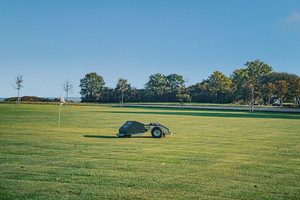
Automation is best viewed as a way of reducing repetitive work rather than eliminating people. Tasks such as ball collection follow predictable routes and must be repeated several times each day, making them well suited to autonomous equipment. Staff can then spend more time on responsibilities that require judgement, customer interaction or course maintenance.
2. ‘Do I need to automate the entire range?’
No.
Automation does not have to be introduced all at once. Some facilities begin with an autonomous ball picker and ditch, while retaining their existing washing and dispensing equipment. Others upgrade washing capacity before considering anything else, with many choosing to integrate washing, transport and dispensing into a single workflow.
3. ‘How do I know where my bottleneck is?’
Every driving range has a throughput limit.
In some facilities, range balls accumulate on the outfield because collection capacity is poor. In others, the limitation occurs after collection, where washing or transport systems struggle to return clean balls to the dispenser fast enough.
Understanding where delays occur is often the first step towards improving efficiency. However, increasing the speed of one process will not necessarily improve the overall operation if another stage remains a limiting factor.
4. ‘Will automation reduce operating costs?’
Labour is one of the largest ongoing costs associated with driving range operations, particularly for repetitive daily tasks. Automation can reduce the number of labour hours required for activities such as ball collection while improving consistency throughout the day.
The exact savings vary between facilities, but many operators value automation not only for reducing labour requirements, but also for improving reliability and maintaining ball availability during busy periods.
5. ‘Can automated equipment work alongside existing systems?’
In many cases, yes.
Driving ranges are rarely built around a single standard layout. Existing washers, dispensers and transport systems often remain in service for many years. For this reason, many automation solutions are designed to integrate with existing equipment where practical, allowing facilities to improve individual stages of the workflow without completely replacing established infrastructure.
6. ‘Is automation only suitable for large facilities?’
No, most sites could usually benefit from automation in some way.
High-volume facilities often experience the greatest labour demand, but smaller ranges can also benefit from reducing repetitive daily tasks. The appropriate level of automation depends less on the size of the facility and more on operational priorities, staffing availability and daily ball usage.
7. ‘What should operators consider before investing?’
Rather than asking which machine to purchase first, it is often more useful to understand how balls move through the entire operation.
How often are balls collected? Where do they go next? Where do delays occur? How much time is spent transporting, washing and restocking balls throughout the day? Answering these questions provides a clearer picture of where improvements are likely to have the greatest operational impact.
Looking beyond individual machines
Driving range automation is continuing to develop, but the objective remains consistent. The goal is not simply to automate individual tasks. It is to create a workflow that keeps range balls moving efficiently from collection through to dispensing.
Every facility will approach that objective differently, but understanding the operation as a connected system is often the best place to start.
For more information: