

China may not appear at first glance to be an obvious golf destination. A population of 1.4 billion is served by only 1,000 clubs and the game is still largely the preserve of the elite. But when China does golf, it tends to be spectacular.
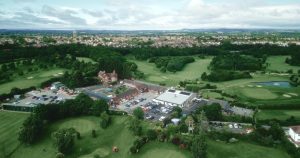
The Mission Hills Haikou Resort, on the large island of Hainan in the South China Sea, certainly caters for the visitor seeking eye-popping scale and luxury. There are no fewer than 10 courses on a resort stretched over 80 square kilometres, making the site roughly equal in size to the entire city of Derby. Opened in March 2010, the resort employs 4,000 staff, has 62 miles of golf-cart paths and lakes that cover 50 acres. Its construction involved the shifting of 11 million cubic metres of earth.
As well as the golf academy, 12 restaurants, a sports and recreation centre, an aquatic theme park, a huge 518-room hotel, high-end shops and Asia’s biggest spa and wellness centre (with over 200 mineral spa pools), there is an on-site ‘Movie Town’, a gigantic tourist destination celebrating China’s architectural and cultural history. It also doubles as a movie set.
Around the resort, elegant chandeliers, man-made waterfalls and imposing statues abound. Glamour is the watchword here. The resort has hosted not just the Omega Mission Hills World Cup, HSBC Champions tournament and World Ladies’ Championship in recent years, but also a biennial World Celebrity Pro-Am event that brings together pro golfers, movie stars and sportsmen from across the globe.
This year’s edition in October saw former Major winners Gary Player, John Daly, Mark O’Meara and Rich Beem line up alongside the likes of actors Michael Douglas and Jeremy Renner, tennis legend Boris Becker, ex-NBA stars Allen Iverson and Yao Ming, plus former Premier League footballers including Paul Scholes, Robbie Fowler and Dwight Yorke. The place has serious pulling power.
Amazingly, despite its vastness, the Haikou club isn’t even the biggest golf club in the Mission Hills stable. Hop back across to the mainland, head east and just before the Hong Kong border is Mission Hills Shenzhen, a 216-hole behemoth officially recognised in the Guinness Book of Records as the largest golf club in the world. Neither club, incidentally, is related to Mission Hills Country Club in California, past host of five women’s Majors. Far from being a remote, exclusive bolt-hole, it is just 20 minutes from the bustling city centre and 10 shuttle buses per day make the 15-minute journey between the resort and Haikou Meilan Airport. Over 180 flights arrive there per day from most major Chinese cities, plus Hong Kong, Bangkok, Kuala Lumpur and Singapore. Many who have visited both Mission Hills’ Shenzhen and Haikou resorts report that the latter is the more aesthetically pleasing of the two.
Situated in the north of Hainan island, (dubbed the ‘Hawaii of the East’), the climate is subtropical, with spectacular beaches nearby and rugged, forested landscape featuring ancient volcanoes. Monsoons and tropical storms are not uncommon between April and October.
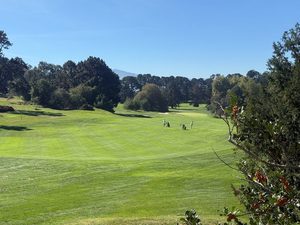
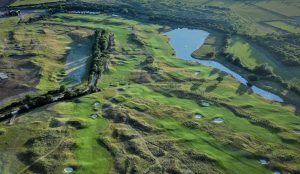
A feature of all 10 courses is the native lava rock formations. During construction most rocks were capped under a metre of soil, but many remain purposely exposed. Hitting one can be entertaining, with the ball pinging off dramatically in random directions. The black lava rock contrasts with the jagged-edged yellow of the bunkers and lush greens and fairways to produce an arresting sight. The Blackstone Course is touted as the resort’s ‘crown jewel’ and it undoubtedly lives up to the billing. At 7,808 yards, it suits the big hitters and its contours are notably undulating, with clever exploitation of the volcanic terrain’s natural climbs and valleys. There is also no rough, with fairway-length turf throughout. The 350-acre course weaves through a striking landscape of mature lychee trees and thick jungle vegetation, with expansive wetlands and lakes.
It begins with a tricky perched green at the end of the first hole, before a zig-zagging par-five second, a tee shot over a ravine at the fourth and all-carry par-threes at the fifth and eighth. Somewhat intriguingly, two successive par-fives at 12 (532 yards) and 13 (681 yards) are marked on the scorecard as having a stroke index of 18 and two respectively. Hole 12 is indeed relatively docile, although the two-tiered green is tricky and cross bunkers 75 yards in front of it provide a tactical challenge. Even in the professional events held there, many pros have opted to lay up in front of them with their second shot. The 13th is long, straight and tree-lined until just under 200 yards from the pin, where it dives down the left, with lava rock behind the green awaiting those brave enough to try and cut the corner with their third shot. The rising 14th has beautiful yet teeth-baring bunkers flick-flacking across its fairway and as legs begin to tire towards the end (if you are one of the rare and tough breed not using a buggy, that is!) there are further tests and risk-reward opportunities at the 17th and last, with a double water-carry, then a nasty side-hill respectively.
Blackstone has been voted No.1 course in China, the best championship course in the Asia-Pacific region (Asia Golf Monthly 2012) and the world’s second best international course (Golf Magazine 2010). Elsewhere, the Sandbelt Trails and Vintage courses are more walkable, though many still go for the buggy option, which is understandable given they’re driven by caddies who offer companionship, course advice and cold beers! Lava Field (93rd best course in the world, Golf.com 2011) shares the same ‘big’ tournament feel of the Blackstone and as its name suggests, it also makes liberal use of the natural volcanic characteristics of the underlying rock. Stone Quarry includes remnants of the area’s industrial history, with coal carts, railroad tracks and abandoned mining equipment now serving as historical features. Meadow Links is worth playing for the sight of its distinctive ‘Church Pew’ bunkers. The Preserve Course is a gentler experience for the amateur player, while Shadow Dunes tests your short game at only par 70, but with monstrous greens. Stepping Stone, meanwhile, is a jaunty par-three course.
Interestingly, the last of the 10 courses is named Double Pin. As the name suggests, it offers the unique challenge of two pins on each green. Each features one kind and one more challenging pin position to choose from. You may find your score on the first few holes determines your pin choice from there on! All of the resort’s courses were designed by the feted Lee Schmidt and Brian Curley, 2011 Golf Architects of the Year and creators of some of the most prestigious venues in Asia, USA and Europe, including Siam Country Club and Amata Spring (Thailand), Stone Forest International and Mission Hills Shenzhen (China), Donald Ross Course (Indiana), Southern Dunes (Arizona), Bali Hai (Las Vegas), Canyon River and the Wilderness Club (both Montana), and Vidbynas (Sweden).
The Mission Hills group is run by brothers Ken and Tenniel Chu, recently voted ‘The Most Powerful Men in Asian Golf.’ They place particular emphasis on growing the game through thriving on-site junior academies staffed by top coaches. They are also keen to tell you about the environmental sustainability of their resorts, protecting the indigenous nature and cultural heritage.
Both of the above may be a response to the Chinese government’s slightly prickly attitude towards golf. Concerned about its elitist reputation and its environmental impact at a time when China’s shrinking agricultural industry is struggling to feed the population, they banned construction of new golf clubs in 2004, then ordered all 88 million Communist Party members to stop playing altogether in 2015, although that crackdown has since been informally relaxed.
Despite this, the game will continue to thrive in China if Mission Hills has got anything to do with it. In Haikou they have created not so much a golf club as a gargantuan ‘golf heaven’, which drips with glamour and opulence, luxurious health-enriching facilities, stunning scenery and characterful yet challenging courses.